
Integrated Soil and Groundwater Remediation Solutions
Carus Europe provides a comprehensive portfolio of in situ soil and groundwater remediation solutions designed to address complex contamination challenges across EMEA and beyond. Building on decades of technical expertise and strong global partnerships, we support consultants, site owners, and contractors with proven technologies, flexible treatment strategies, and local technical support.
Our remediation offerings extend well beyond traditional approaches, combining chemical treatment, bioremediation, adsorption, and integrated remedy strategies to deliver effective, site-specific solutions.
What We Do
Carus Europe supports remediation projects from initial site assessment through full-scale implementation, helping customers:
- Treat contaminated soil and groundwater in situ
- Address source zones and manage contaminant plumes
- Apply targeted treatment trains for complex sites
- Help balance performance, sustainability, and regulatory requirements
Our solutions are designed to be adaptable, supporting everything from focused source treatment to long-term plume management.
Remediation Technologies
Chemical Treatments (ISCO / ISCR)
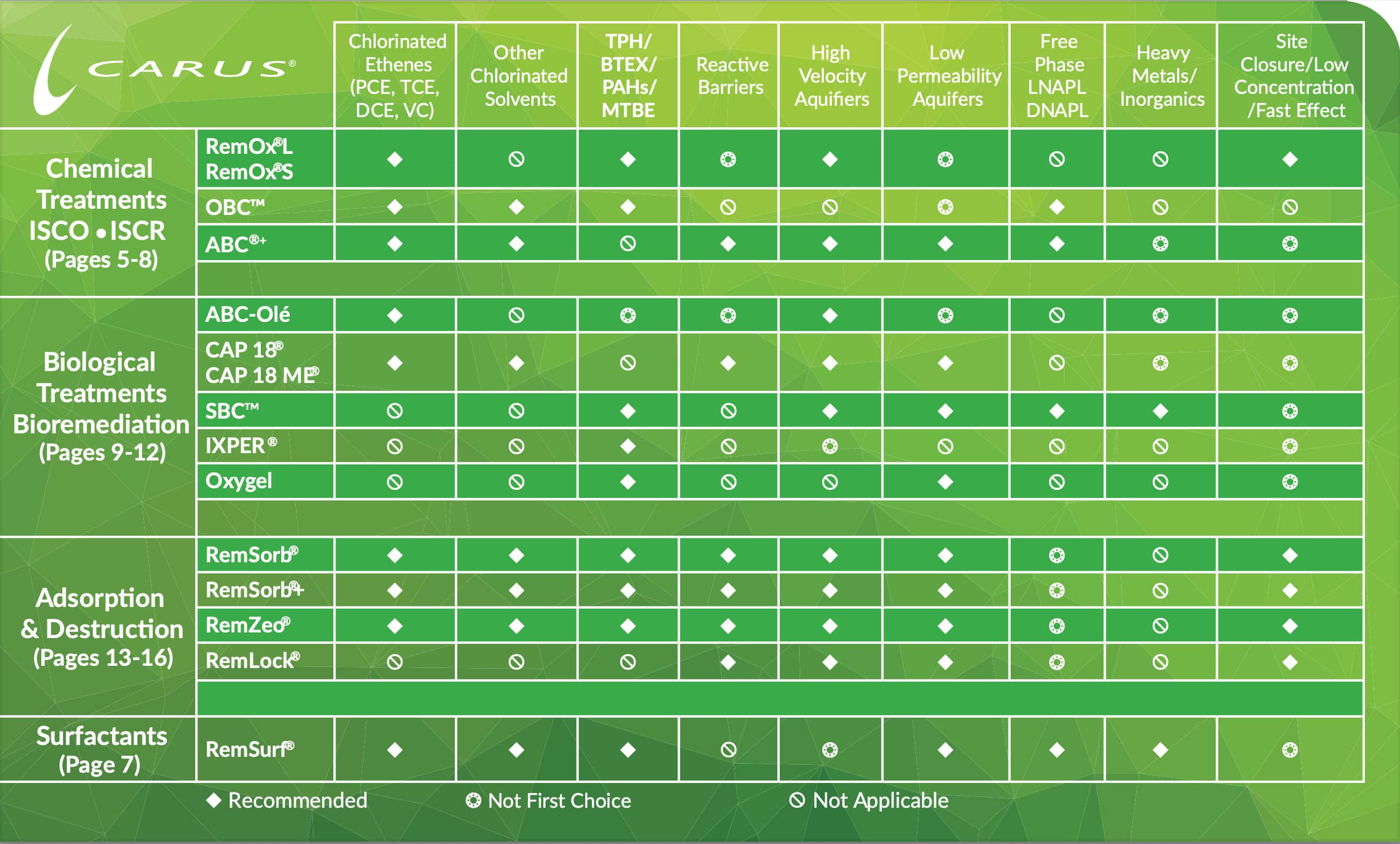
In Situ Chemical Oxidation (ISCO) and In Situ Chemical Reduction (ISCR) technologies treat contamination directly in the subsurface, without the need for excavation or soil removal. These approaches rapidly destroy or transform a wide range of organic contaminants in soil and groundwater and are well-suited for source zone treatment and aggressive mass reduction. Technologies and products include:
- Remediation grade, permanganate-based oxidants (RemOx® S ISCO reagent, RemOx® L ISCO reagent)
- A mixture of sodium persulfate and calcium peroxide (Oxygen Biochem, or OBC™ from Redox Tech)
- ABC+ (Anaerobic BioChem+) by Redox Tech – a combined ISCR technology formulated using ABC-Olé and zero valent iron (ZVI), mixed on a site-specific basis
- Combined oxidation–reduction strategies
In situ chemical treatments are commonly applied for chlorinated solvents, petroleum hydrocarbons, and recalcitrant organic compounds.
Aerobic & Anaerobic Bioremediation
Bioremediation Technologies (Aerobic & Anaerobic)
Carus Europe offers a broad range of bioremediation solutions designed to support both aerobic and anaerobic biological processes, depending on site conditions, contaminant types, and remediation objectives. These technologies focus on supplying appropriate electron acceptors or donors to sustain microbial activity and overcome natural limitations in subsurface environments.
Aerobic Bioremediation
Aerobic bioremediation relies on oxygen as the terminal electron acceptor to support microbial degradation of organic contaminants. In many contaminated aquifers, oxygen is rapidly depleted, limiting further biodegradation. Carus Europe offers multiple solutions for safely and effectively delivering oxygen, or alternative electron acceptors, into the subsurface.
Key contaminants addressed:
- Total Petroleum Hydrocarbons (TPH)
- BTEX
- MTBE / ETBE
- PAHs
- Residual free phase hydrocarbons and LNAPL
Aerobic and sulfate-reducing bioremediation products include:
- IXPER® 75C (Calcium Peroxide) by Solvay – a solid oxygen-releasing compound that provides extended oxygen delivery to support aerobic biodegradation in soil and groundwater
- Oxygel by Biorem Engineering – a pumpable, inorganic oxygen-releasing gel designed for improved distribution and long-term oxygen release in anoxic aquifers and sediments
- Sulfate BioChem (SBC™) by Redox Tech– a sulfate-based amendment that supports long-term anaerobic biological oxidation under sulfate-reducing conditions, offering an alternative to oxygen-based treatment where higher electron-accepting capacity is required
Anaerobic Bioremediation (Reductive Dechlorination)
Anaerobic bioremediation supports reductive dechlorination (dehalorespiration) processes, in which microorganisms use chlorinated compounds as electron acceptors under strongly reducing conditions. These processes are critical for treating chlorinated solvents and other halogenated organic contaminants in groundwater.
Key contaminants addressed:
- Chlorinated ethenes (PCE, TCE, DCE, VC)
- Chloroethanes and chloromethanes
- Pesticides and other halogenated compounds
- Hexavalent Chromium
Anaerobic bioremediation products include:
- CAP 18® and CAP 18 ME® – engineered non-emulsified carbon substrates that support long-term anaerobic biodegradation and reductive dechlorination
- ABC-Olé by Redox Tech– an emulsified fatty acid ester substrate designed to deliver sustained electron donor supply in high-permeability aquifers
These products are designed to provide controlled, long-lasting electron donor availability, enabling microbial communities to fully degrade chlorinated contaminants through to non-toxic end products.
Adsorption & Destruction
Adsorption technologies are used to immobilize contaminants, control plume migration, and reduce contaminant bioavailability. These solutions are often applied as standalone remedies or integrated into treatment trains.
Technologies and products include:
Activated carbon–based sorbents:
- RemSorb® colloidal carbon (adsorption of any organic contaminant)
- RemSorb®+ ZVI colloidal carbon (designed for adsorption and destruction of chlorinated/halogenated contaminants)
Zeolite and mineral-based adsorption media:
- RemZeo® iron zeolites (modified iron zeolites for adsorption and destruction of organic pollutants)
- RemLock® colloidal iron oxides (adsorption metals and metalloids)
These approaches are particularly effective for long-term plume control and risk management. RemSorb, RemSorb+ and RemLock can be blended in the field for commingled contamination of organics and metals.
Remediation Surfactants
Surfactants are used to enhance contaminant mobilization, improve treatment distribution, and increase contact between reagents and contaminants.
Technologies and products include:
- RemSURF® remediation surfactant
Surfactants are often used in combination with chemical or biological treatments to improve overall remedy performance.
Integrated & Combined Remedies
Many remediation challenges require more than a single technology. Carus Europe specializes in integrated remedy strategies, combining multiple treatment approaches to address complex site conditions.
Examples include:
- Chemical treatment followed by bioremediation for polishing
- Adsorption-based barriers combined with source treatment
- Sequential aerobic and anaerobic treatment phases
This flexible, treatment-train approach allows remediation strategies to evolve as site conditions change and cleanup goals are achieved.
Why Carus Europe
- Broad remediation portfolio tailored for EMEA markets
- Strong technical expertise and application support
- Established partnerships with leading remediation technology providers
- Experience navigating European regulatory frameworks
- Global resources with local responsiveness
Carus Europe works closely with customers to design practical, defensible remediation strategies that deliver measurable results.
Talk to Our Remediation Experts
Whether you are addressing a complex source zone or managing long-term plume behavior, Carus Europe can help identify the right remediation approach for your site.
Contact Carus Europe to discuss your project needs or request technical support.